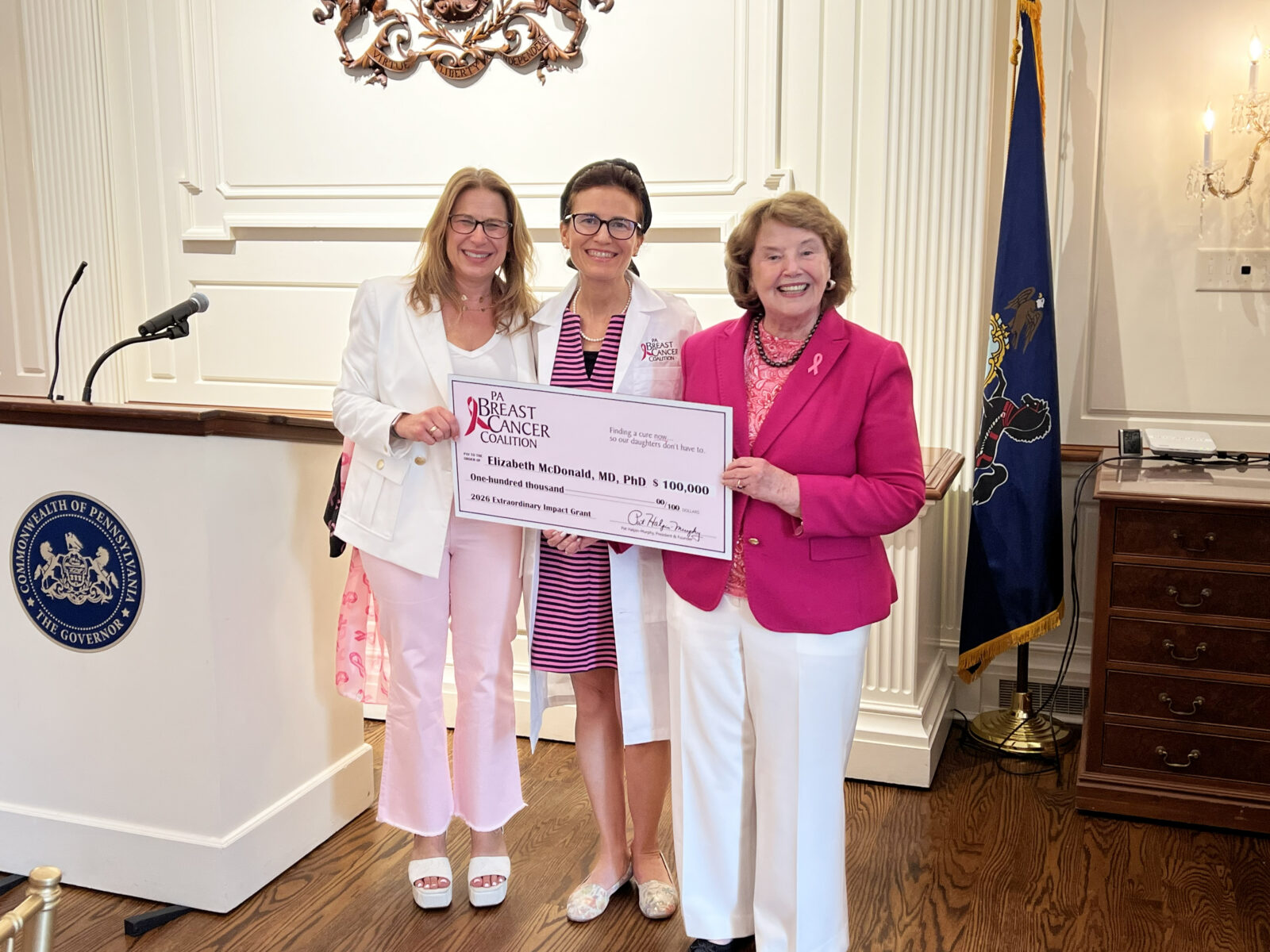
PENNSYLVANIA – The PA Breast Cancer Coalition (PBCC) awarded a second $100,000 grant to Elizabeth McDonald, MD, PhD, of Penn Medicine to advance her study of GLP-1 medications and their impact on breast cancer incidence. Pennsylvania First Lady Lori Shapiro and PBCC President Pat Halpin-Murphy announced the honor and presented the award to Dr. McDonald last week at the Governor’s Residence. Dr. McDonald plans to use the funding to continue her promising research into GLP-1 usage and its possible role in breast cancer prevention. Initial results of the first study, funded by the PBCC, indicate a 30-percent reduction in breast cancer diagnoses in women taking GLP-1 medications. The findings were opens in a new windowpublished in JCO Oncology Practice and presented at the American Society of Clinical Oncology (ASCO) Conference and made headlines across the country.
“Dr. McDonald’s GLP-1 research represents the kind of bold, innovative science the PA Breast Cancer Coalition is proud to fund. Her discoveries could hold the answer to a question researchers have been asking for years: ‘How can we prevent breast cancer?,’” said PBCC President and Founder Pat Halpin-Murphy. “It is our honor to support this second phase of Dr. McDonald’s study that could bring us closer to a future where fewer families are touched by breast cancer.”
Some 30 million American adults are currently taking glucagon-like peptide-1 (GLP-1) receptor agonists prescribed to treat Type 2 diabetes and chronic weight management. Dr. McDonald’s study gathered imaging data from a large group of women to determine whether GLP-1 use in patients were associated with a decrease in the rate of breast cancer diagnoses. Her team did this in two ways by analyzing:
- The full group – over 111,000 women between ages 45 and 80 with BMI >25. Some took GLP-1s and some did not. When comparing data, the breast cancer diagnosis rate was 35% lower in patients who took GLP-1s
- A matched cohort group – two groups of 15,000+ women each with similar characteristics (race, age, ethnicity, breast density, diabetes status, etc.) Some took GLP-1s and some did not. When comparing data, the breast cancer diagnosis rate was 30% lower in patients who took GLP-1s.
With assistance from the PBCC’s Extraordinary Impact Grant, Dr. McDonald aims to further understand how GLP-1s might affect breast cancer biology and decide which blood and tissue biomarkers to measure in a future clinical trial. Her team hopes to soon launch INSPIRE, a multi-center clinical trial designed to test GLP-1/GIP therapy as a breast cancer prevention and interception strategy for women at elevated risk.
About PA Breast Cancer Coalition
The PA Breast Cancer Coalition is a 501(c)3 organization that represents, supports and serves breast cancer survivors and their families in Pennsylvania through educational programming, legislative advocacy and breast cancer research grants. The PBCC is a statewide non-profit organization dedicated to finding a cure now…so our daughters don’t have to. For more information, please call 800-377-8828 or visit www.PABreastCancer.org.

Want to learn more? Dr. McDonald will present a workshop on her GLP-1 breast cancer research at the 2026 PA Breast Cancer Coalition Conference! Click here to register now and reserve your seat!